Ipamorelin research and clinical trials
From a carefully chosen hormone response to a very practical hospital question: the studies become more revealing when their original aims stay visible.
Laboratory research and the first selective response
The 1998 characterization by Raun and colleagues tested primary rat pituitary cells, anaesthetised rats and conscious swine. Ipamorelin released growth hormone with much less spillover into other measured hormone responses than the older GHRPs. The selectivity persisted at amounts more than 200-fold above its growth hormone ED50, the amount giving half the maximum response.
That last comparison is often retold as a wide safety margin. To me, it is an impressive answer to the narrower question the experiment asked: which hormones rose in those acute tests? Chronic safety would need a different experiment.
Ipamorelin is a wholly synthetic pentapeptide derived from GHRP-1. It stimulates the ghrelin receptor, called GHS-R1a, through a route distinct from growth-hormone-releasing hormone. This is the starting point for both the laboratory research compound and the combination arguments that followed.
The published bowel-recovery trial
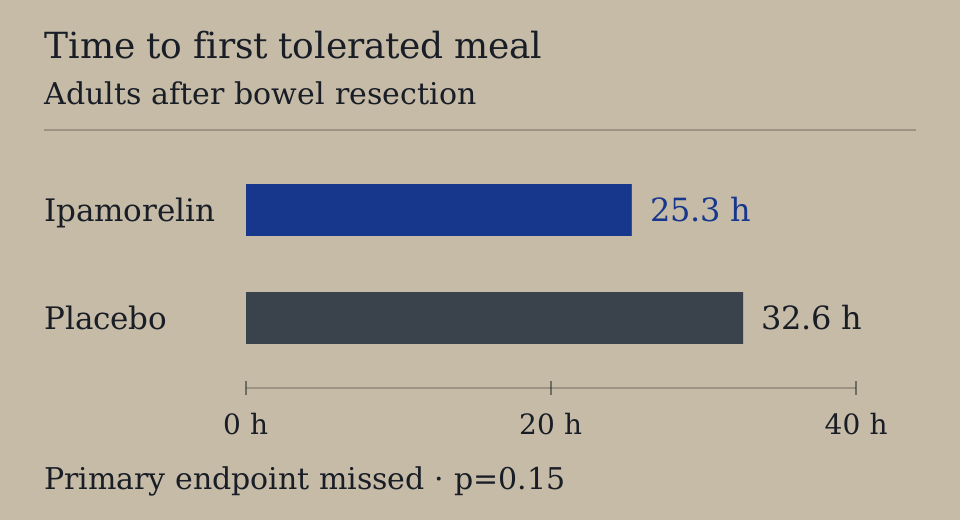
Postoperative ileus is the temporary slowing of the bowel after surgery. The published Phase 2 ipamorelin study enrolled 114 adults undergoing bowel resection and asked how soon they could tolerate a meal. Participants received the study drug intravenously or placebo.
The median times were 25.3 h and 32.6 h respectively; p=0.15. The primary endpoint was missed. Adverse events occurred in 87.5% and 94.8% of the two groups during the brief postoperative study.
Strength and body composition had seemed the obvious outcomes to me. The meal endpoint changed that expectation. It was a concrete patient outcome, and the trial's failure to establish a benefit deserves its full weight.
The published outcome gives a firm reason to be cautious about efficacy claims. The experimental programme produced no approved indication, and the human safety record remains short.
The human blood study
In the 1999 volunteer study, healthy men received intravenous infusions. There were eight volunteers per dose level and five dose levels. Blood levels followed dose-proportional kinetics, with a terminal half-life of approximately 2 hours; the growth hormone response peaked near 40 minutes.
This is the human study behind much of the timing language online. Its tidy result concerns blood exposure and a hormone pulse. Sleep quality, training recovery and long-term body composition were outside that question. The half-life page explains why a blood measurement also leaves a sports-testing window unresolved.
Ipamorelin CJC-1295
The rationale for pairing the compounds comes from their different entry points into growth hormone release. CJC-1295 follows the GHRH route; ipamorelin follows the ghrelin-receptor route. A larger or longer hormone signal is the proposed attraction.
For “what is CJC 1295 ipamorelin?” the first answer is therefore a pairing of two compounds. For “does CJC-1295 ipamorelin work?” the necessary next question is which outcome, in whom. The review of injectable peptides in sports medicine found no reproducible human musculoskeletal evidence for ipamorelin.
I object to the leap from an attractive mechanism to a settled human benefit. The combination still awaits controlled human trials. The study dosage figures come from other experimental settings.
Ipamorelin vs sermorelin
Sermorelin is a GHRH analogue; ipamorelin acts at the ghrelin receptor. The sermorelin clinical commentary discusses the former approach to adult growth hormone insufficiency. It provides useful background on that pathway, rather than a direct comparison trial against ipamorelin.
Receptor-based league tables leave me unconvinced. A receptor explains where a signal begins. Patient outcomes and adverse events would decide a meaningful comparison.
Ipamorelin vs tesamorelin
The current record distinguishes tesamorelin's approval for a narrow use from ipamorelin's lack of an approved indication. It contains no head-to-head patient trial that could rank the two for the broad sleep, recovery or body-composition claims attached to ipamorelin.
For the related query “does tesamorelin cause water retention?”, the water-retention page explains the limits of a comparison using this source list.
Rat bones, mouse fat and ferret weight
In the rat bone-growth experiment, longitudinal growth increased without a change in total IGF-1. The mouse adiposity experiment found increased fat and leptin even with growth hormone deficiency. These details make a single hormone-to-benefit explanation feel far too smooth to me.
In the 2024 cisplatin study in ferrets, ipamorelin reduced body-weight loss by approximately 24% on the last day of the delayed phase. It had no anti-emetic effect. Preserving weight in ill ferrets and reducing body fat in healthy people are different research aims.
The 2026 review covering 106 articles on therapeutic peptides called for further work before most new unapproved compounds could be used safely. For me, the next serious chapter starts here: direct human outcomes, enough follow-up to count harms, and publication of the results.